Magnus Carlsen's chess, by the numbers
October 12, 2026 · 374 games: 317 on chess.com, October 2024 to October 2026, and 57 classical, 2023 to 2026
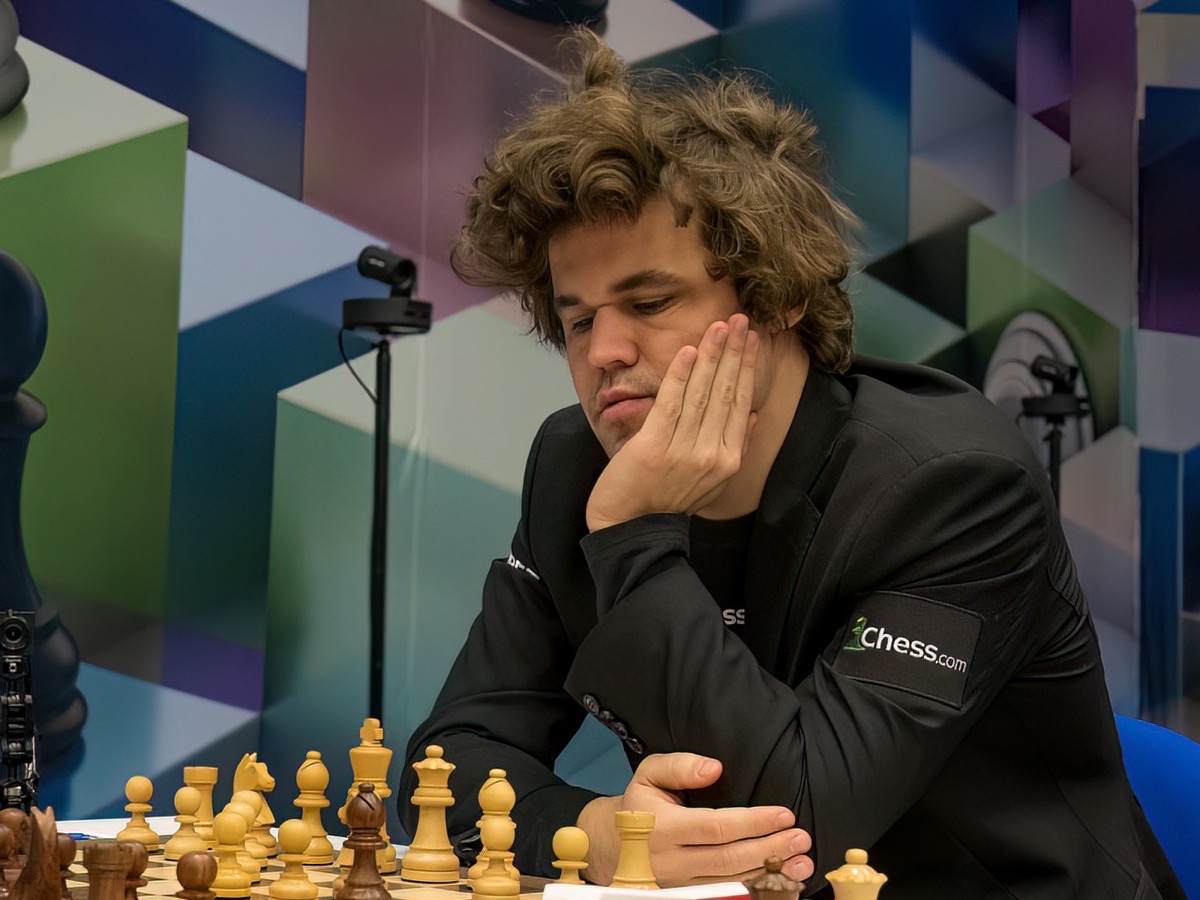
Carlsen's last 200 blitz games and two years of rapid games on chess.com, every move checked by Stockfish, counted the way anyone's games are. Here is what the count found.
Carlsen's games have been studied as closely as any player's, but nearly always one game at a time, by people with a board in front of them. Counting is the other way to look. The same questions a club player's games get asked were asked here, across 317 recent online games: which piece slips, what gets converted, which losses contain a mistake and which don't, what the engine makes of every piece given up.
Some of the answers are what you'd expect at the top. Some aren't. The piece most likely to slip is the rook, not the queen. Half the pieces they lose, they meant to lose. And the losses are rarely a blunder at all. The point isn't that the world's highest-rated player has habits; everyone does. It's that the habits are countable, and this is what they count to.
For scale, before the counting starts: the median opponent in these blitz games was rated 3104 on chess.com (the live blitz leaderboard starts around 2800), 133 of the 200 games were against players rated 3000 or more, and Carlsen scored 77% in those. Across 1,965 opening moves, the blunder rate rounds to zero. The first serious mistake of a blitz game typically arrives on move 34; of a rapid game, on move 48. When a sacrifice was the best move on the board, they played it 60 times out of 69 in blitz and 37 out of 37 in rapid. That is the level everything below is measured against.
How they play
Every player gets one of four profiles from two measures: how often they force matters with a check or a capture, against what the position asks for, and how rarely one of their pieces is left loose. Carlsen's pieces are almost never loose (90 of 100 in blitz, 94 in rapid; the line is at 64). On forcing, they sit right on the line: 50 in blitz, 55 in rapid, with the line at 52. So the blitz games come out as the Steady Hand, quiet and safe, and the rapid games as the Striker, a little more forcing than the position asks for. More forcing with ten minutes than with three.
When a slip comes, it comes with the rook.
1.9x their usual slip rate on rook moves in blitz
A slip is a move that cost 10 or more points of winning chances. Across 200 blitz games, moves with Carlsen's rook slip at 1.9x their usual rate (69 of 1272 rook moves, in 49 different games). Moves to the seventh rank slip at 2.1x (30 of 459), and moves that leave a piece where a pawn can hit it at 2.6x (23 of 282). The queen, the piece a club player is told to watch, isn't on the list.
Half the pieces they lose, they meant to lose.
51% of pieces taken on the very next move were given up on purpose; for most players, about 9%
In 200 blitz games, 47 times Carlsen lost a knight, bishop, rook or queen outright: taken by the opponent's very next move, with nothing won back. In 24 of them (51%) the engine saw nothing wrong with the position afterward, so the piece was given up on purpose. Most of those, 19, were pieces left where they could be taken because something else mattered more; 4 were moved onto the square where they were taken, the sacrifice as a spectator pictures it, and in 16 of the 24 the move was also the engine's first choice. The queen most often: 9 times. For most players, about 9 in 100 of those captures are deliberate; the rest are mistakes.
Three first moves, and the odd Bird.
40% of 104 blitz games as White opened with d4
As White in blitz, Carlsen opened with d4 42 times (40%), e4 31 (30%) and c4 23 (22%): three moves for 96 of 104 games. Most players, at every level, have one first move they play more than half the time; Carlsen's biggest is 40%, and 1.c4 comes four times as often as among titled players online (5%). The other eight are the fun ones: b3 three times, Nf3 three, and f4 twice, Bird's Opening, in a three-minute game against a 3000-rated opponent.
Carlsen almost never loses to a blunder.
15 of 28 blitz losses had no blunder in them
Of their 28 blitz losses, 15 have no blunder in them: no single move cost 30 or more points of winning chances. In rapid it is 6 of 10, and in 57 classical games from 2023 to 2026, 9 of 10. They are outplayed slowly, or not at all. Both rapid losses to Hikaru Nakamura in July 2025 are among them: the first and the second.
Once clearly winning, they finish it.
93% of decisive advantages converted in blitz
Carlsen reached a decisive advantage in 161 blitz games and won 149 of them (93%). In rapid, 60 of 68 (88%). Eight blitz games got away. For scale: Lichess blitz players rated 2000 and up convert 79% of the games they are clearly winning (the top tenth, 86%); Sindarov, at 3200 on chess.com, 83%.
In rapid, the Black games are the harder half.
0.79 points a game as White, against 0.65 as Black
In 117 rapid games Carlsen scores 0.79 points a game as White and 0.65 as Black. The first move is worth about 0.05 in most players' games, so most of the gap is their own. It is made of draws: 47% of their rapid games as Black are drawn, 29% as White. In blitz the gap doesn't appear.
The full reports
- Carlsen's blitz report
200 blitz games (3+0 and 5+0) on chess.com as MagnusCarlsen, July to October 2026: 155 wins, 17 draws, 28 losses. Download the games (PGN) - Carlsen's rapid report
117 rapid games (mostly 10+0) on chess.com as MagnusCarlsen, October 2024 to August 2026: 63 wins, 44 draws, 10 losses. Download the games (PGN) - Carlsen's classical report
57 classical games, 2023 to 2026: Norway Chess 2023, 2024, 2025 and 2026, the TePe Sigeman 2026, and the 2024 Olympiad, from Lichess's broadcasts. 20 wins, 27 draws, 10 losses. Download the games (PGN)
Each report opens as a deck of slides, one finding to a slide, with the positions behind every number. A blunder is a move that cost 30 or more points of winning chances; winning chances are the engine's estimate of how likely a player is to win, from 0 to 100.
How this was measured
Plysight analyzes games the same way for everyone: Stockfish evaluates every move, and the findings are counted from those evaluations. The reports compare a player with others at their rating where a fair comparison exists; at Carlsen's rating there is none, so those lines are left out. Advice lines, written for a player reading their own report, are left out too. The positions on this page were checked again at a deeper search before they were shown. The six house words the reports use are defined on each report's last slide.
Games from chess.com's public archive of MagnusCarlsen. Plysight is independent of chess.com and of Carlsen. Carlsen's FIDE profile. Published October 12, 2026; updated October 12, 2026.
Piece art by Cburnett, CC BY-SA 3.0.