Gukesh Dommaraju's chess, by the numbers
October 29, 2026 · 79 classical games, August 2025 to September 2026, from the Sinquefield Cup to the Olympiad
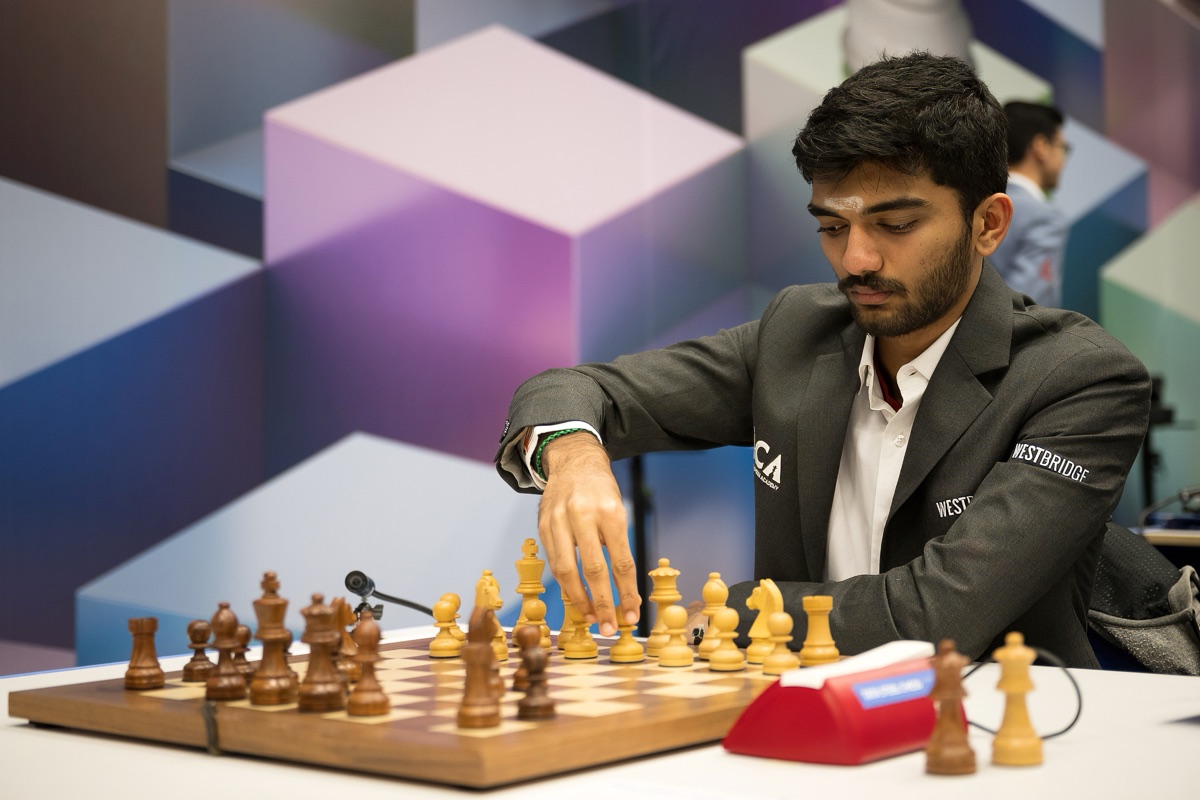
Gukesh's 79 classical games from August 2025 to September 2026, from the Sinquefield Cup to the Olympiad, every move checked by Stockfish, counted the way anyone's games are. Here is what the count found.
Gukesh won the world championship in December 2024, against Ding Liren in Singapore, and defends it against Javokhir Sindarov in Geneva in late November 2026, over 14 classical games. This page counts how they played in the 14 months before the match: 79 classical games across the Sinquefield Cup, the FIDE Grand Swiss, the European Club Cup and the World Cup in 2025, and Tata Steel, Prague, Norway Chess, the Chennai Grand Masters and the Olympiad in 2026, every move checked by the engine, with the same questions a club player's games get asked.
How they play
Every player gets one of four profiles from two measures: how often they force matters with a check or a capture, against what the position asks for, and how rarely one of their pieces is left loose. Gukesh sits under the forcing line at 46 (the line is at 52), and their pieces are almost never loose (94 of 100; the line is at 64): the Steady Hand, the same corner as Sindarov's classical games (50 and 98). The other scores: closing 84, accuracy 91.
20 of 21 classical losses had no blunder in them.
20 of 21 classical losses had no blunder in them
Gukesh lost 21 of the 79 classical games, and in 20 of them no single move cost 30 or more points of winning chances: they were outplayed a little at a time. The one that turned on a move was against Nodirbek Abdusattorov at Tata Steel 2026, where 36...Rg5 left the pawn on f6 to the queen. The field they lost in: a median opponent rated 2705, 52 games against players within 100 points (scoring 44%), 25 against players 100 or more points lower (66%), and two against Carlsen at Norway Chess, both lost. For scale, Sindarov's count is 3 of 3, from 71 games.
When the best move was a hard one, they almost always found it.
360 of 363 times the best move was a retreat, in 79 classical games, they played it
The reports keep count of the moves club players miss most: a sacrifice, a retreat, declining a recapture. In Gukesh's 79 classical games, when the best move was a sacrifice (32 times) or declining a recapture (67 times), they played it every time; a retreat, 360 of 363 times; a quiet move, 1,622 of 1,631. Their average loss per move against the engine's choice was 0.14 of a pawn: 0.05 in the opening, 0.11 in the middlegame and 0.19 in the endgame, with the first serious mistake typically on move 36. The yardsticks, from the same source and the same checks: Sindarov, retreats 272 of 273 and quiet moves 1,368 of 1,371 in 71 classical games; Carlsen, retreats 199 of 200 in 57.
Once meaningfully up, they won 21 of 25.
84% of decisive advantages converted in classical
Gukesh was meaningfully up, three pawns' worth or more by the engine, in 25 classical games and won 21 of them (84%); 3 were drawn and 1 lost. The draws were against Sindarov and Hans Niemann at Tata Steel 2026 and Dmitry Andreikin at the Chennai Grand Masters 2026; the loss was to Arjun Erigaisi at the same event. Counted the same way from the games, Sindarov won 23 of 25 in their 71 classical games, and Caruana 25 of 25.
Against Sindarov: two classical games, one loss and one long draw.
2 classical games against Sindarov on Lichess's broadcasts: a loss in 2022, a draw in 2026
The two have met twice in classical on Lichess's broadcasts. At the Sharjah Masters in May 2022 Sindarov won with White in 32 moves. At Tata Steel 2026, in round 1, Gukesh gave up the queen on move 39, and from move 43 to move 68 with two rooks and a knight against the queen, the engine had them five pawns' worth or more ahead, checked again at depth 22. On move 68 they took on g2 with the rook; the knight retreat to d6 kept the advantage. White's queen then gave check until the game was drawn on move 78.
As White, 1.e4 in 20 games and 1.d4 in 16.
50% of 40 classical games as White opened with e4
As White, Gukesh opened 1.e4 in 20 of 40 classical games, 1.d4 in 16, and 1.Nf3 and 1.c4 twice each, scoring 50% with each color. As Black against 1.e4 the answer was 1...e5 in 10 of 22 games, 1...c5 and 1...c6 six times each; against 1.d4, 1...Nf6 in 12 of 16. Sindarov leans the other way as White: 1.d4 in 11 of 21 classical games, 1.e4 in 8.
The full reports
- Gukesh's classical report
79 classical games, August 2025 to September 2026: the Sinquefield Cup 2025 (9), the FIDE Grand Swiss 2025 (11), the European Club Cup 2025 (5), the FIDE World Cup 2025 (4), Tata Steel 2026 (13), the Prague Masters 2026 (9), Norway Chess 2026 (10), the Chennai Grand Masters 2026 (7) and the Olympiad 2026 (11), from Lichess's broadcasts. 21 wins, 37 draws, 21 losses. Download the games (PGN)
Each report opens as a deck of slides, one finding to a slide, with the positions behind every number. A blunder is a move that cost 30 or more points of winning chances; winning chances are the engine's estimate of how likely a player is to win, from 0 to 100.
How this was measured
Plysight analyzes games the same way for everyone: Stockfish evaluates every move, and the findings are counted from those evaluations. The reports compare a player with others at their rating where a fair comparison exists; at Gukesh's rating there is none, so those lines are left out. Advice lines, written for a player reading their own report, are left out too. Gukesh's blitz on chess.com was looked at and left out: 51 blitz games there in 2025 and none since July 2025 are not their chess now. Sindarov's and Carlsen's numbers on this page come from Sindarov's page and Carlsen's page, the same checks on the same site. The six house words the reports use are defined on the report's last slide.
Classical games from Lichess's broadcasts, August 2025 to September 2026. Plysight is independent of Lichess, chess.com and Gukesh. Gukesh's FIDE profile. Published October 29, 2026; updated October 29, 2026.
Piece art by Cburnett, CC BY-SA 3.0.